Design Data. Not Divs.
Content modeling is the backbone of any serious application. Pragma CMS lets you define strict schemas via UI or PHP Hooks. Build relational structures your API can consume instantly, without EAV overhead.
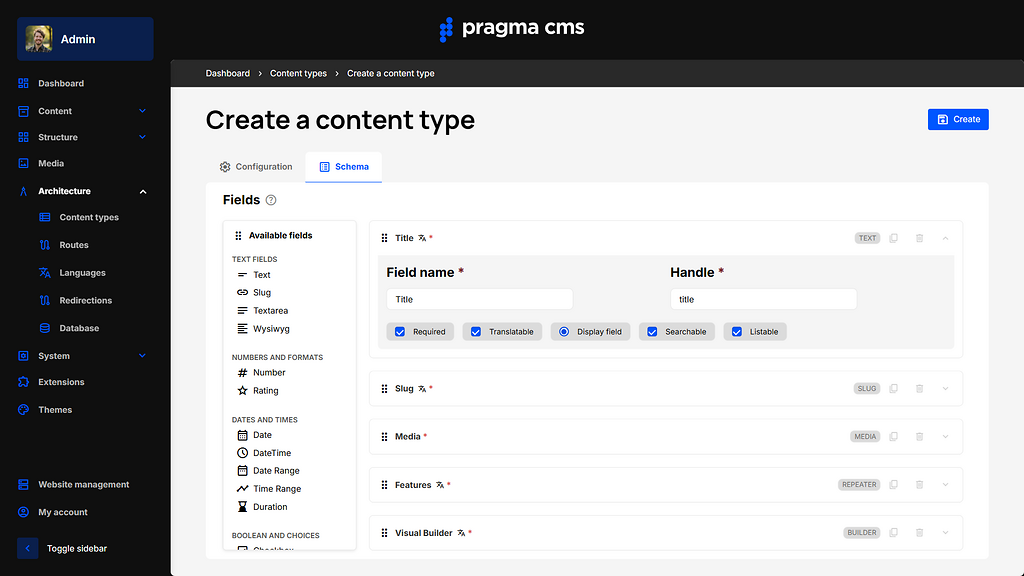
Structured Logic. Absolute Predictability.
Generic CMS store everything in EAV tables. Pragma avoids this entirely with strict relational modeling.
Define (Blueprints)
Build collections, singles, and nested Structures using our intuitive visual schema builder or clean PHP configuration files.
Populate
Auto-generated admin forms + server-side validation
Query (Deliver)
Retrieve raw, structured arrays natively in PHP or expose clean JSON via our REST API. Perfect indexing, fast execution
Engineered for database efficiency.
Collection & Single Blueprints
Create distinct templates for recurring contents (Articles, Products) or unique page layouts (Homepage) with strictly typed schemas.
Advanced Relational Fields
Build robust content structures. Link entries to authors, categories, or custom taxonomies with indexed relational checks.
Single Source of Truth
Field configurations map directly to database columns, strict input sanitization, and frontend views, preventing data drift.
Composite Repeater Fields
Handle nested lists or repeated layout elements with optimized JSON serialization, keeping your database footprint clean.
Scale without database performance issues.
Our content modeling engine is built on standard relational database principles. We do not bury your data under generic, slow meta-tables.
Zero Query Abuse
No massive JOIN chains to fetch a single item. Queries complete in fractions of a millisecond.
Native MariaDB/MySQL Storage
Direct column mapping and native JSON database fields ensure optimal sorting and retrieval.
Schema Portability
Blueprints are saved as file-based configurations, allowing easy Git versioning, branching, and team sync.
Automatic Sanitization
Every field enforces strict validation (int, float, html, slug, json) at the schema level before saving.
Frequently Asked Questions
Basic fields are stored in standard indexed columns. Complex or repeated structures (like repeaters) are serialized into standardized JSON database columns, ensuring swift parsing and zero table bloating.
Yes. You can define your schemas in plain PHP arrays within your site directories. The CMS automatically handles the database schema synchronization through the Content Types CRUD interface.
Absolutely. All relations are strictly declared with matching foreign key constraints and indexes, preserving referential integrity and performance under high loads.